SEO for Travel Bloggers: Tips for Ranking First on Google

Live Adventure Travel contains affiliate links and is a member of the Amazon Services LLC Associates Program. If you make a purchase using one of these Amazon links, I may receive compensation at no extra cost to you. See my Disclosure Policy for more information.
When I first started my travel blog I had no idea how to develop a readership. And quite frankly, I was under the impression that all I needed to do is write the blog post. Then, somehow, people would magically find it and start reading. And, boy was I wrong. Fast forward two years, I started to understand the power of SEO. This new found knowledge gave me the opportunity to write fully optimised blog posts that ranked on the first page of google. To do this I invested in a Keyword Research tool known as Keysearch, this enabled me to find search terms my blog could actually rank for, rather than targeting far too competitive keywords. As my SEO efforts began to kick in, I started to jump out of bed every morning to see my stats booming. That is why I want to write this post, a beginners guide to SEO for Travel Bloggers.
What is SEO?
Now, before we begin, let’s have a quick look at SEO. SEO stands for Search Engine Optimisation. It is essentially a formula, or a strategy that allows you to speak googles language. And ultimately, optimise your posts to rank on the first page of Google. Bringing you thousands of readers each week.
SEO for Travel Bloggers Tips and Strategy
When I first started to think about my travel blog SEO I thought it would be possible to find all the information I needed free online. And while was possible to an extent, I found that each answer lead to more questions.
I figured all my time spent looking up free guides could be better used if I invested in the tools needed to fast track my knowledge of SEO. There a two major purchases I made that quite literally changed the travel blogging game for me.
The first being SEO the Easy Way by Make Traffic Happen (which is unfortunately no longer being sold but I just want to say a big thank you the Gemma and Laura for years of help). And Keysearch, my favourite affordable SEO research tool.
Now, don’t worry, for those of you not yet ready to make a purchase, I do reference some free tools that you can use throughout the post.
In the first half of this SEO travel blog guide I am going to discuss the top things you should do before you even begin to write.
Get 20% off KEYSEARCH by using the code KSDISC at checkout

1. Define Your Blog Post Topic
Before thinking about SEO you must first choose a topic to write about.
Perhaps you have just returned from a trip across Europe.
You have 101 possible blog post idea’s. And have no idea where to start.
Believe me, I know just how you feel you. I have been in that situation before.
The important thing is to pick one topic and see it through.
2. The power of low competition search term
Once you have decided on your blog post topic it is time to choose a Keyword you would like to rank for.
A Keyword is a phrase or term that people type into to Google to find information on a topic.
We need to optimise our blog post to contain the Keywords we wish to rank for.
This will increase our chances of ranking for our targeted search term.
However, it is important to choose the correct Keyword.
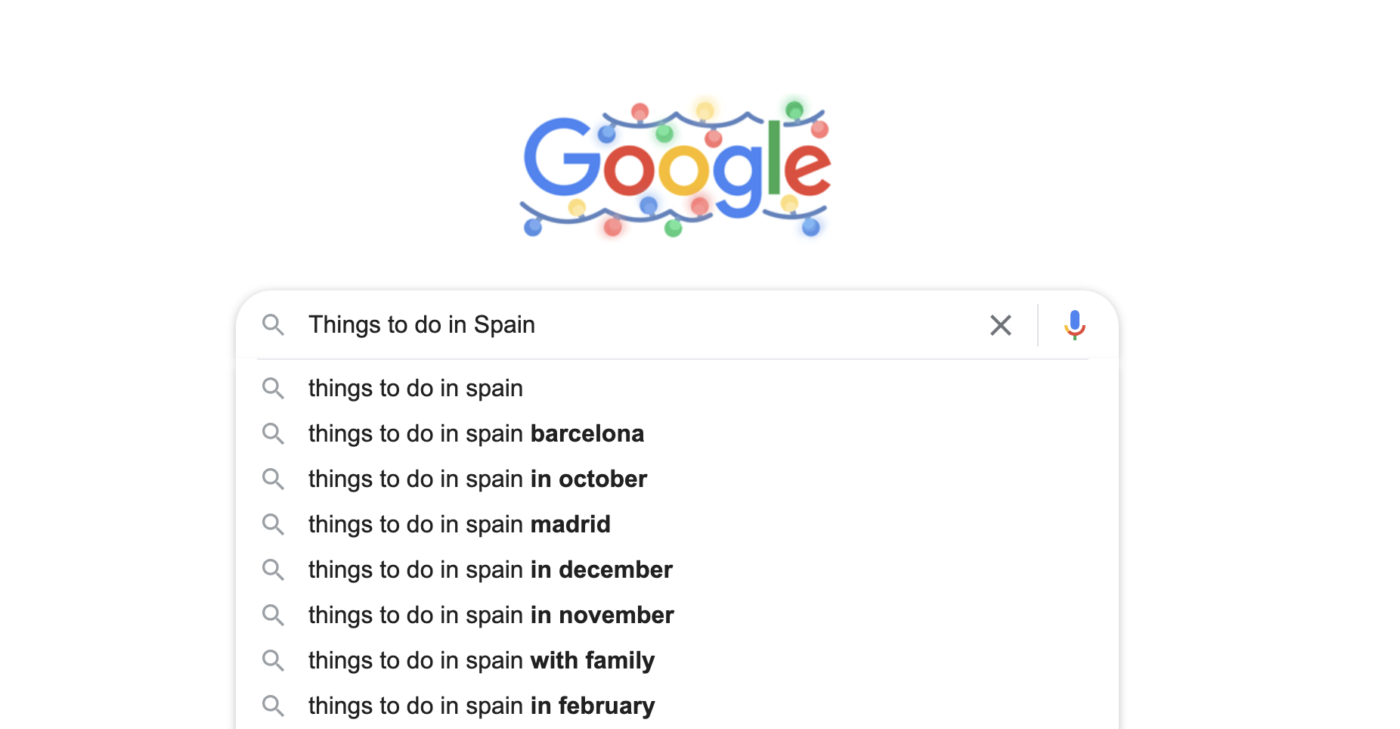
Let’s take a trip to Spain as an example. It can be tempting to write a post targeting the search term ‘Top Things to do in Spain’. And while this is a highly searched topic, it is also insanely difficult to rank for. Due to the high competition. Everybody wants to rank for this term therefore there are many blog posts targeting it.
It is important to find a low competition search term for the topic we wish to write about. That way we increase our chances of ranking and driving traffic over to our blogs. Which brings us to the next step, finding a SEO tool.

3. Finding a Keyword Research Tool
In order to find low competition search terms we must use an SEO research tool.
Now, while there are some free trail options such as Uber Suggest.
These tools only allow five daily searches to determine the search volume, rank difficulty and competitor analysis of your desired search term.
I hate to be the bearer of bad news, but in order to find low competition search terms. It is important to invest in a Keyword Research Tool.
I recommend Keysearch for those looking for an affordable and user friendly tool.
Get 20% off KEYSEARCH by using the code KSDISC at checkout
4. Find your main Keyword
Once you have determined the best keywords research tool for you. It is time to find your main keyword.
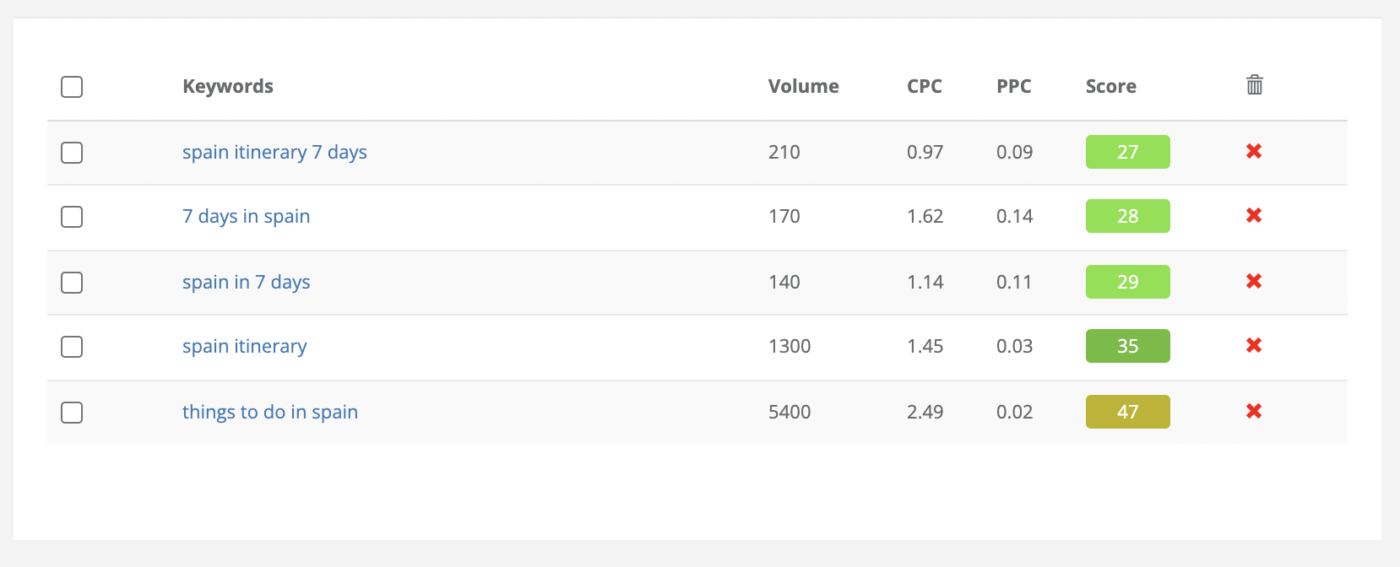
Let’s go back to Spain as an example, Keysearch tells us that while ‘Things to do in Spain has a high search volume of 5400 monthly searches the competition score is a high 47.

This means that ‘Things to do in Spain’ is too competitive and difficult to rank for.
Therefore, we must look at a different search term.
Let’s try ‘Spain Itinerary’ as the next keyword. According to Keysearch, it has a lower search volume of 1300 however it is a lot less competitive with a difficulty ranking of 35.
Now this is a good keyword to use in article, however, let’s narrow it down a little further.

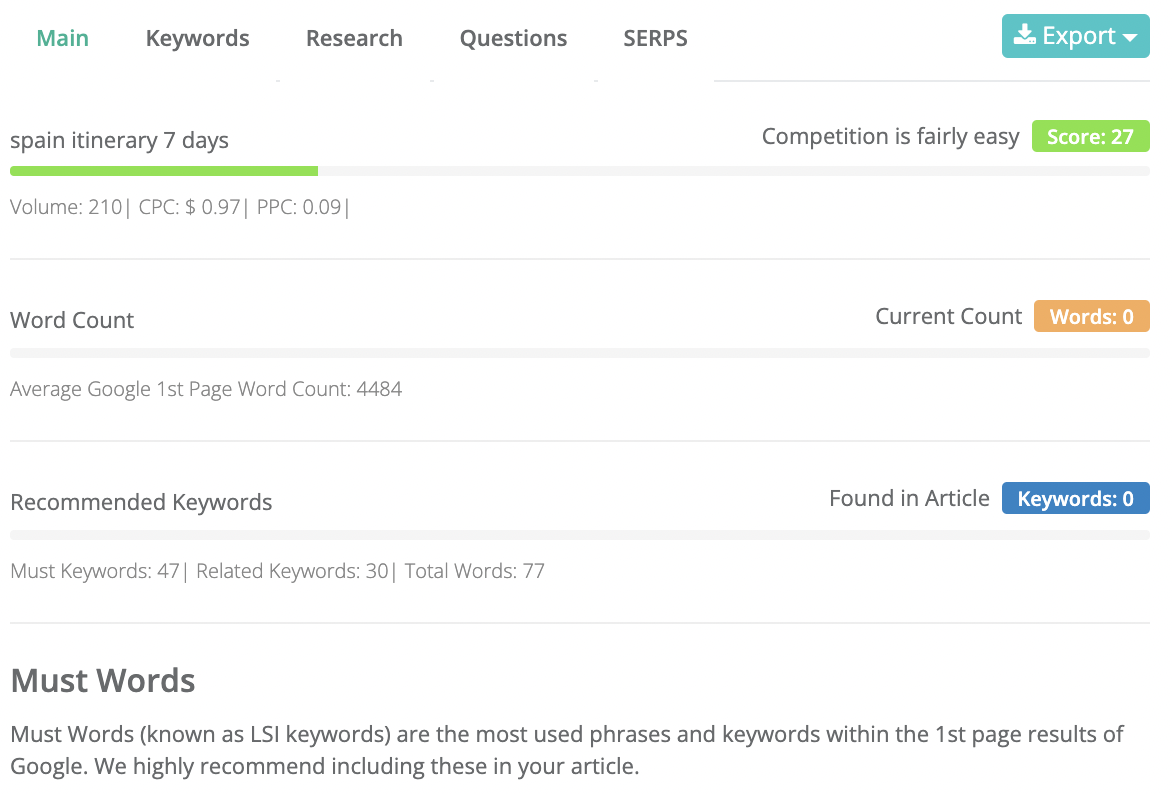
Let’s try ‘Spain Itinerary 7 days’ as a Keyword. According to Keysearch, this term has a much lower search volume of 210. This is still a good level of monthly searches.
The keyword ‘Spain Itinerary 7 days’ is also a much less competitive search term. This mean you have higher odds of ranking on the first page of google for this search.

Now, we could continue to dive deep, to find an even lower competition score yet a good monthly search volume. However, this guide is only covering the basics of SEO, so let’s continue on with the post by targeting ‘Spain Itinerary 7 days’ as our main Keyword.
Get 20% off KEYSEARCH by using the code KSDISC at checkout

5. Find Additional Keywords
Now, while the search terms ‘Things to do in Spain’ and ‘Spain Itinerary’ are of a high competition score. That does not mean we should not include them in our post.
Your main keyword should not be the only keyword you try to rank for.
You should include you main keyword in your H1 Title, your first paragraph and the ALT tag for your first image.
Then it is time to include alternative keywords you wish to rank for throughout your posts.
To find alternative keywords I like to use Keysearch list tools. I research alternative Keywords, combine them all into one list and prioritise the low competition yet good search volume.
An example of Keysearch list feature can be seen down below.

6. Analysis Competing URL’s
Before writing an SEO optimised blog post it is important to first check out the competition.
This is not to copy what others in your niche are doing, but to simply evaluate if you can write a better more in-depth guide.
Your aim is to always to write what is best for your readers. If you readers are asking a question it is your goal to answer it.
Now, it is of course possible to check on the competing URLS by simply searching your search term on google. However, this kind of analysis gives you is extremely limited data.
In keysearch, I like to search my desired keyword and see who else is ranking for it. From there, we can determine a few things, the Competing URL’s Domain Authority, if they have included the target keyword in the URL and how many backlinks they have for that particular post. This data gives us a much clearer indignation if we can outrank this URL in Google Search.
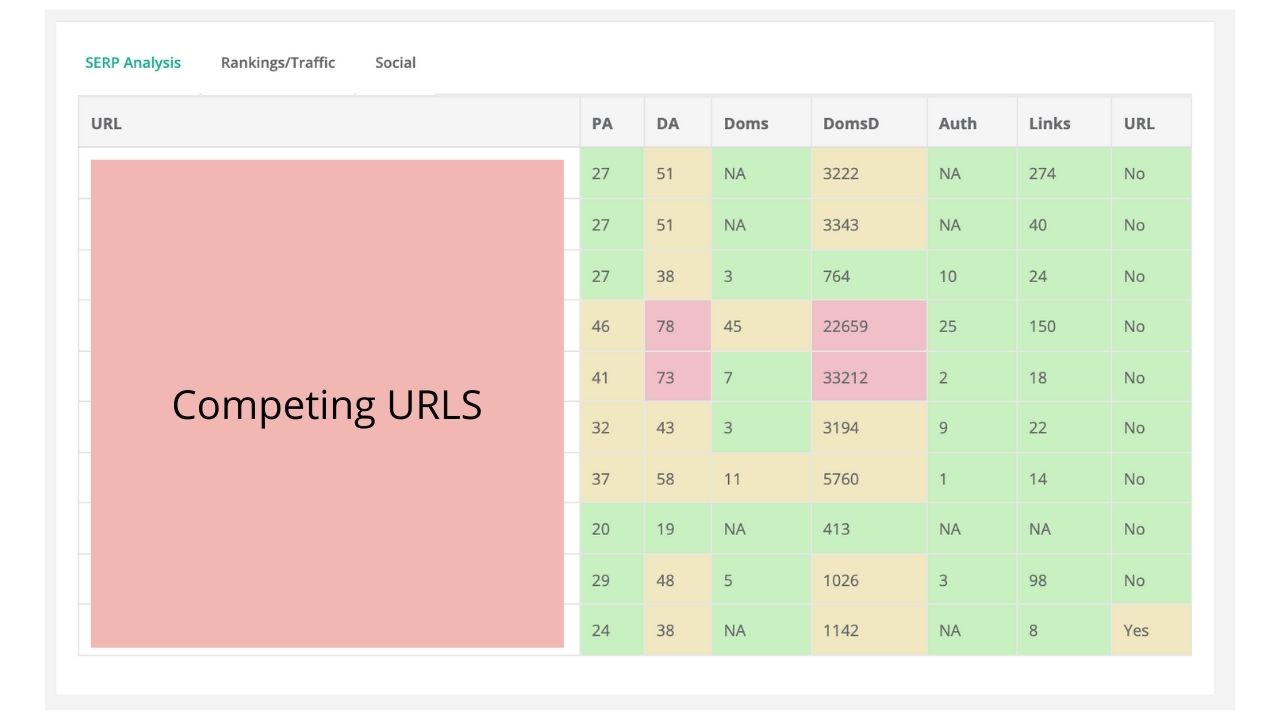
I also like to use Keysearch Content Assistant tool to analysis the average word count of ranking posts for a my desired key word. Keywords used by other URL’s ranking for that term and must used words.
There is a text box included in this feature which allows you to analysis your post compared to competing URLS. A screenshot of this feature can be seen down below.

7. Write an SEO Optimised Post
You guessed it, the next thing to do is write an SEO optimised post.
I am going to highlight briefly the key factors involved in getting a post to rank.
I include my main Keyword in my H1 heading, first paragraph and URL.
I like to include 10 – 15 keyword variations throughout my blog post, depending on the word count of each piece. I include these in my H2/H3 headings and paragraphs. It is important not to Keyword Stuff.
SEO for Travel Blogs: Things you should do after writing your post
Ok, so we have discussed the top things to do to improve search rankings before you even begin to write your blog post. Now it is time to find out how you can improve your SEO travel blog after the post is complete.

8. Google Analytics & Search Console
It is important to ensure you have both Google Analytics and Search Console set up for your site.
Google Analytics gives you an in-depth in-site into your blogs traffic source and demographics.
Search Console is used to resolve issues such as server errors, site speed, hacking and malware.
It is also a great place to determine what keywords a certain blog post is ranking for.
Once I complete a new post or make changes to an old one, I submit the URL to search console to have Google recrawl my site for updates.

9. Be Patient & Track Your progress
It is important to note that it can take anywhere from 1 to 6 months for a blog post to rank on Google.
In fact, I have had posts rank on the first page a whole year after I wrote them.
Although it is tempting, try not to edit a new blog post until at least 6 months after you have wrote it. You need to give google time to analyse the post.
Track your blog post performance. Now, this is much easier to do with a tool like Keysearch as they have a rank track tool that monitors your posts position on google.
However, it is possible to track you post position for free by using incognito mode on google. Manually find you posts position and keep track of it on a google spreadsheet. However, This can be time consuming to do for each post.
Below is a screenshot of the Keysearch Rank Tracking Tool, it highlight the keyword, the position on google and the search volume. It also displays if the keywords position has moved up or down that day.
Get 20% off KEYSEARCH by using the code KSDISC at checkout

10. Develop strong writing skills
It is important to have a strong voice when writing a travel blog.
Having the ability to draw the reader in, to provoke emotion and tell a compelling story is a great way to cheap returning viewers.
If you feel you need to improve in this area, I highly suggest signing up to Skillshares free trail.
I use Skillshare to learn about a range of different topics from SEO, Video Editing, Photography and Writing.

11. Improve your site appearance
Finding a layout that works for both you and your readers is supper important.
You wouldn’t think this is something that has much impact on SEO but it is one of the essential aspects.
If your site is user friendly and layout well, your readers are likely to stick around for longer.
Long time spent on page is a good signal for google. This is turn could lead to your post being pushed further up the search results.

12. Travel Vlogging
Another great way to increase SEO efforts and double time spent on the page is combining the use of video content and written content.
This is something I have been experimenting with recently. I have noticed blog posts with related youtube videos tend to rank higher in search results.
It also increases the readers time spent on page which in turn encourages Google to push the blog post higher on the search page.
PS: If you have an interest in video travel content I would love for you to subscribe to My Youtube Channel.
If you have an interest in growing a youtube audience I highly recommend checking out Lost Creator Academy. The course teaches you everything you need to know to become a full time content creator. You can check out my detailed review here.

13. Building Backlinks
Another vital part of SEO is building backlinks.
This is a way of telling Google your website is a valued source of information and increases you authority on a topic.
There are a few way to build backlinks:
- Collab Post: Writing a short snippet for other travel bloggers. You can apply for these posts in facebook groups like this.
- Guest Posts: Writing a detailed blog post for another blogger in exchange for links back to your site. Here is another great facebook page for this.
- Link Swaps: This is an older way to build backlinks. This method is not entirely liked by Google. This facebook group allows you to swap links without coming across as spammy.

14. Safe & Fast Site
The final point on our SEO for travel bloggers guide is all about Speed and Saftey.
It is important too have a fast and reliable website.
This in turn, reduces bounce rate, increases time spent on page and encourages reoccurring visitors.
My favourite site for improve speed is gtmetrix.com.
It is also a great idea to purchase a HTTPS domain. This reasures users that your site is safe to browse.
SEO for Travel Website
Thanks so much for reading! I hope this post helps you when writing SEO Keyword for your travel blog.
PS: I hope you liked the little Graphics, I’m a visual learner so I thought this was nice way to add colour and visual memory to the post.